
BANKING & FINANCIAL SERVICES
The cryptography behind every transaction - finally visible.
Payments, settlement and inter-institution trust all rest on cryptography that quantum computing will eventually undermine. Quantum Sentinel helps financial institutions discover it, measure their exposure, and plan the transition on their own terms.
Why it matters here
Financial institutions keep records for years – often a decade or more – to satisfy anti-money-laundering, market-conduct and reporting obligations. That same longevity is what makes today’s encrypted data a target: an adversary can harvest it now and decrypt it once a capable quantum computer exists. The two functions most exposed are the ones the sector depends on most – key establishment (RSA and elliptic-curve key exchange) and digital signatures (used for non-repudiation, contracts and code-signing), where a future quantum computer could retroactively forge trust that was assumed permanent.
The regulatory picture
These are the drivers shaping cryptographic governance in financial services – not claims that any framework mandates post-quantum cryptography by name.
DORA
The EU’s Digital Operational Resilience Act, in force since January 2025, requires financial entities to govern cryptography and key management and to keep pace as cryptanalysis evolves - the crypto-agility foundation a quantum transition depends on.
PCI DSS 4.0
Requirement 12.3.3 obliges organisations to maintain a documented, regularly reviewed inventory of the cryptography protecting cardholder data. A cryptographic inventory is no longer optional - it’s a control.
SWIFT Customer Security Programme
The CSP’s controls tighten expectations on transport security, key sizes and PKI across the correspondent-banking network.
Industry momentum
The BIS Innovation Hub’s Project Leap and the Europol-convened Quantum Safe Financial Forum have moved quantum-safe payments from theory to tested practice, and urged institutions to prioritise the transition.
Where cryptography hides in Financial Services
Payment HSMs & Key Hierarchies
Payment HSMs and key hierarchies.
TLS & Mutual-TLS
TLS and mutual-TLS between institutions.
SWIFT Connectivity
SWIFT connectivity and messaging.
Enterprise PKI & Certificates
Enterprise PKI, certificates and code-signing.
Database Encryption
Database and field-level encryption.
EMV & Card Cryptography
EMV chip, card and online-banking cryptography.
How Quantum Sentinel helps
Enterprise CBOM
A living inventory of the cryptography behind payments, PKI and inter-bank connectivity.
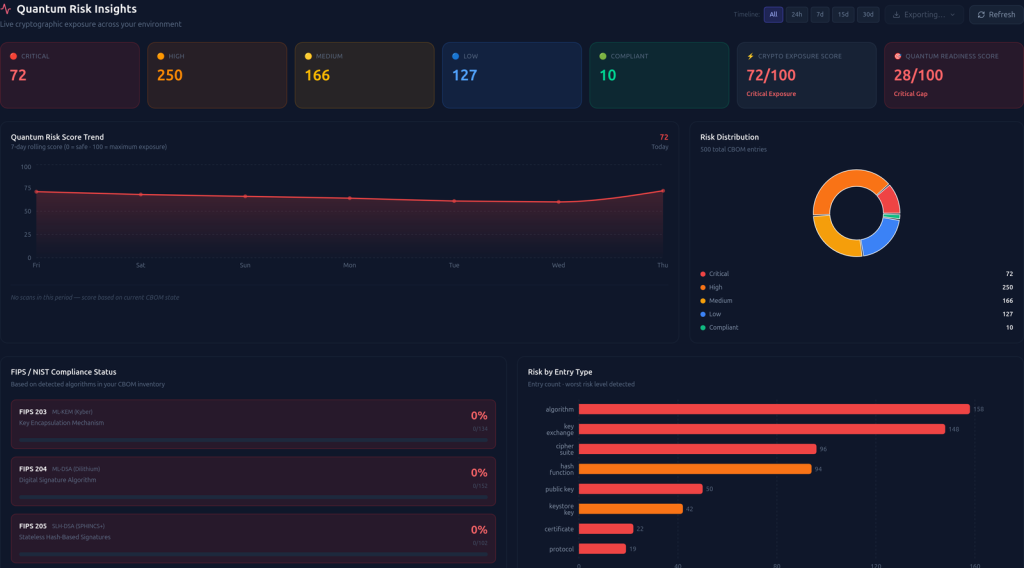
Cryptographic Exposure Score
See which systems carry the greatest business risk - payments and settlement first.
Quantum Readiness Score
Track progress toward PQC readiness over time, for risk and audit committees.
Outcomes for financial services
- Meet PCI DSS 4.0 and DORA cryptographic-inventory expectations with evidence, not spreadsheets
- Prioritise migration by business exposure - payments and settlement first
- Give risk and audit committees a defensible quantum-readiness position
Know your cryptographic exposure before your regulator asks.
The first step is always the same: visibility. Request a demo and see your cryptographic exposure.