TELECOMMUNICATIONS
Know exactly which cryptography quantum computing threatens - and which it doesn’t.
Not all telecom cryptography is equally at risk. Quantum Sentinel helps operators find the asymmetric cryptography that quantum computing genuinely threatens, across networks and equipment built to run for decades.
Why it matters here
Telecom is the sector where cryptographic nuance matters most. The symmetric algorithms protecting much of the network and subscriber authentication – AES, and the Milenage and TUAK functions on the SIM – are comparatively resistant to quantum attack and can be strengthened by increasing key sizes. The acute risk is asymmetric cryptography: the RSA and elliptic-curve algorithms behind PKI, key exchange, firmware signing and subscriber-privacy concealment must be replaced, not resized. Network equipment stays in service for ten to twenty years or more, so keys and hardware deployed today have to survive well into the quantum era – which is why the industry’s guidance treats a cryptographic inventory as the essential first step.
The regulatory picture
These are the drivers shaping cryptographic governance in telecommunications – not claims that any framework mandates post-quantum cryptography by name.
GSMA Post-Quantum Telco Network
The GSMA’s telecom task force and its PQ.03 guidelines make a cryptographic inventory the mandated first step and set out a phased, use-case-by-use-case migration model.
NIS2
As essential entities under the EU’s NIS2 Directive, operators face explicit obligations on the use of cryptography and encryption.
National migration timelines
UK NCSC and EU roadmaps give critical-communications operators clear reference milestones through to 2035.
NIST baseline
ML-KEM (FIPS 203) and ML-DSA (FIPS 204) provide the standardised replacements for the exposed asymmetric primitives.
Where cryptography hides in Telecommunications
Backhaul & Interconnect
Backhaul and interconnect (IPsec, TLS, MACsec).
SIM, eSIM & Provisioning PKI
SIM, eSIM and remote-provisioning PKI.
5G Subscriber-Privacy Concealment
5G subscriber-privacy concealment (SUCI / ECIES).
Firmware & NF Signing
Firmware and network-function signing.
Lawful-Intercept & Retained Data
Lawful-intercept and retained data (long-life, HNDL-relevant).
Signalling & Roaming Interconnect
Diameter/SS7 signalling and roaming interconnect.
How Quantum Sentinel helps
Enterprise CBOM
A living inventory spanning networks, SIM/eSIM PKI and signalling.
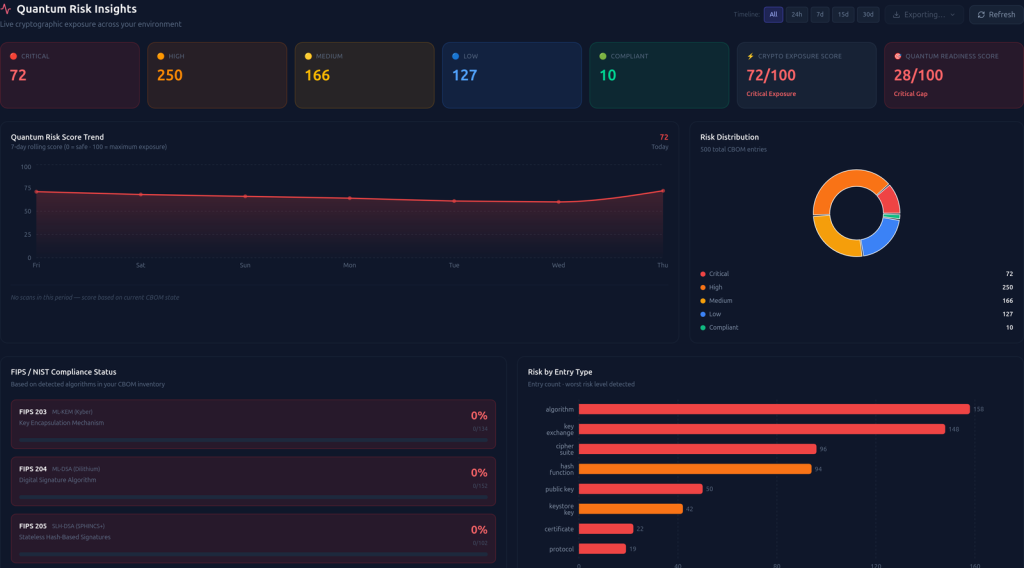
Cryptographic Exposure Score
Separates genuinely exposed asymmetric cryptography from resilient symmetric cryptography.
Quantum Readiness Score
Track progress aligned to GSMA PQ.03 migration milestones.
Outcomes for telecommunications
- Separate the genuinely exposed (asymmetric) from the comparatively safe (symmetric), so effort goes where it counts
- Build the GSMA-aligned cryptographic inventory across networks, equipment and code
- Prioritise long-life equipment and long-retention data first
Find the cryptography quantum computing actually threatens.
The first step is always the same: visibility. Request a demo and see your cryptographic exposure.